


Wall Sconce Installation Reference · Bathroom Planning
A bathroom mirror can make two wall lights look perfectly balanced on paper and still feel wrong once the room is finished. The decision is not simply “side sconces or one light above.” It is a relationship between the mirror, the face, the available wall width, the fixture's projection, the existing electrical points, and whether the exact fixture is suitable for the location.
Choose side sconces first when you have enough wall width and want light to arrive from both sides of the face. Choose an above-mirror fixture when side clearance is limited, the mirror nearly fills the wall, or the existing architecture strongly favors one centered point. In either case, mock up the actual fixture footprint before the electrical position is finalized.
Do not treat a bathroom collection label as proof that every fixture is suitable for every bathroom location. Verify the exact product's listed rating, the planned position relative to water, manufacturer instructions, and local requirements with the appropriate professional.
The mirror is not the only thing the sconces must align with
Most vanity-lighting mistakes begin with a drawing that includes the mirror but leaves out the person. A pair of sconces can be perfectly symmetrical around a mirror and still place the brightest part of the fixture too high, too low, or too far out from the face. A light above the mirror can be beautifully centered yet create a strong top-down effect that feels less useful at the sink.
Start with three layers at the same time: the mirror edge, the user's standing face position, and the complete fixture silhouette. That last part matters because a wall sconce is not a point. It has a backplate, an arm or body, a shade, and a projection from the wall. A narrow vertical sconce and a wide globe sconce can share the same electrical-box center and still occupy the wall very differently.
Beside the mirror
Best starting direction when the wall has enough width for a balanced pair and the goal is more even face-level illumination from both sides.
Check: mirror width, fixture width, outside-wall clearance, door or cabinet swing, eye-level relationship, projection, and exact bathroom suitability.
Above the mirror
Often the cleaner solution when the mirror is wide, the side walls are tight, or the vanity is centered under one usable electrical point.
Check: mirror top clearance, fixture depth, reflected view, light-source visibility, ceiling relationship, and whether the single fixture spreads useful light across the vanity width.
When side sconces usually make the stronger starting point
Side lighting earns its reputation because it can place light closer to face level instead of sending most of it downward from above. That does not mean every pair will automatically be flattering or bright enough. Shade opacity, lamp position, fixture spacing, surrounding wall color, mirror size, and the room's other light sources all change the result. But as a layout strategy, a pair gives you two opportunities to shape the face zone instead of one source centered above it.
Use the face zone, not a universal mounting number
Online diagrams often reduce wall-sconce placement to a single height from the floor. That is convenient, but it ignores countertop height, mirror height, fixture height, and the people using the bathroom. Instead, stand where a user normally stands at the sink and mark the approximate eye zone on painter's tape. Then place a full-size paper outline of the proposed sconce beside the mirror.
The question is not whether the backplate center hits a standard number. The question is whether the luminous portion of the fixture sits in a useful vertical relationship to the face without putting an exposed lamp directly into the normal standing sightline.

Check the space between the mirror and the fixture body
A pair that is pushed tightly against the mirror can look accidental. A pair placed too far away can feel disconnected from the vanity and may shift the light away from the face. The useful gap depends on the actual sconce width and mirror width, so use the real dimensions rather than copying a fixed spacing rule from another bathroom.
For a renovation, tape the mirror perimeter and both fixture silhouettes onto the wall before ordering. Step back from the doorway, then stand at the sink. A layout that looks balanced from the front may still crowd a medicine-cabinet door, towel bar, side wall, trim line, or nearby door swing.
When an above-mirror fixture is the better answer
Side sconces are not automatically superior when the architecture fights them. A wide mirror that nearly spans the vanity, a narrow powder room, a tall medicine cabinet, or a door close to the vanity may leave no credible side position. In those rooms, forcing a pair can create awkward clearances and a visually compressed wall.
An above-mirror fixture can be the more coherent choice when it is sized and positioned as part of the mirror composition. Think of the mirror and light as one vertical stack: vanity, mirror, fixture, then ceiling. The fixture needs enough breathing room above the mirror frame, but it also needs to feel connected to the mirror rather than floating near the ceiling.
A single source must do more work
With one fixture above the mirror, pay more attention to how the light source is distributed across the fixture. A tiny central source above a wide double vanity is solving a different problem from a broader horizontal fixture. Product photography alone cannot tell you whether the illumination will be even across every face position, so exact photometric performance should not be assumed unless the manufacturer provides it.
If the bathroom also has ceiling lighting, the above-mirror fixture does not need to carry the room alone. It can be one layer in a broader plan. The important point is to decide what job it is doing before you buy it: general brightness, face-zone support, or decorative light near the mirror.
A simple four-part test before you choose the layout
| Test | Side sconces | Above mirror |
|---|---|---|
| Wall width | Needs usable space on both sides of the mirror. | Useful when side clearance is limited. |
| Face-level relationship | Can bring light closer to both sides of the face. | Light arrives primarily from above; geometry matters more. |
| Fixture footprint | Check two backplates, two projections, and nearby doors/cabinets. | Check mirror-top clearance, fixture span, and ceiling relationship. |
| Existing electrical point | Do not force a pair without confirming the wall and electrical plan. | Can suit a centered existing point, but the fixture still must fit the mirror composition. |
1. Draw the mirror as a fixed object
Use the actual mirror width and height, not a product-page thumbnail. Include the frame if there is one. If the mirror is recessed, hinged, or part of a medicine cabinet, include its opening path.
2. Add the real fixture silhouette
Use the listed overall dimensions for the exact option you plan to buy. If those dimensions are missing or unclear, pause. Do not assume a product image is to scale. WREA's Size & Installation Guide is the right place to organize room dimensions before you commit.
3. Add the person and normal sightline
Stand at the sink at the distance you actually use. Check whether an exposed bulb, clear shade, or open-bottom shade will sit directly in the normal view. Two fixtures with the same outer dimensions can feel very different depending on where the lamp is visible.
4. Add the room's moving parts
Open every nearby door and cabinet. Check drawers, medicine cabinets, towel bars, trim, switches, outlets, and anything else that occupies the wall. For projecting sconces, also consider how far the fixture extends into the room and whether it can be bumped during normal use.

Bathroom suitability has to be checked on the exact product
This is where a design decision becomes a product-specification decision. A fixture can look ideal beside a mirror and still be the wrong choice for a particular bathroom location if the listed environmental rating or manufacturer guidance does not support that use.
WREA currently groups multiple wall sconces inside the Bathroom Lighting collection. That is useful for browsing, but the collection itself is not a substitute for the exact product page. Some current decorative wall-sconce pages list an ingress-protection rating of IP20. That means you should not infer suitability for splash-prone or damp locations from the collection label or the room photo alone.
Do not let the existing junction box choose the wrong fixture
In remodels, the easiest-looking option is often to buy whatever visually fits the existing wall box. That can save wall work, but it can also lock the room into a poor mirror relationship. Before purchasing around an existing point, document the box location, the visible opening, wall finish, mirror dimensions, and the fixture backplate dimensions. A backplate that appears large enough in a product image may not cover the actual opening.
If the existing point is above the mirror but you want side sconces, or vice versa, that is not a cue for a DIY workaround. It is a cue to stop and have the site reviewed before ordering. Wall construction, conductors, grounding, support, and local requirements are professional decisions.
Fixture shape changes the side-vs-above decision
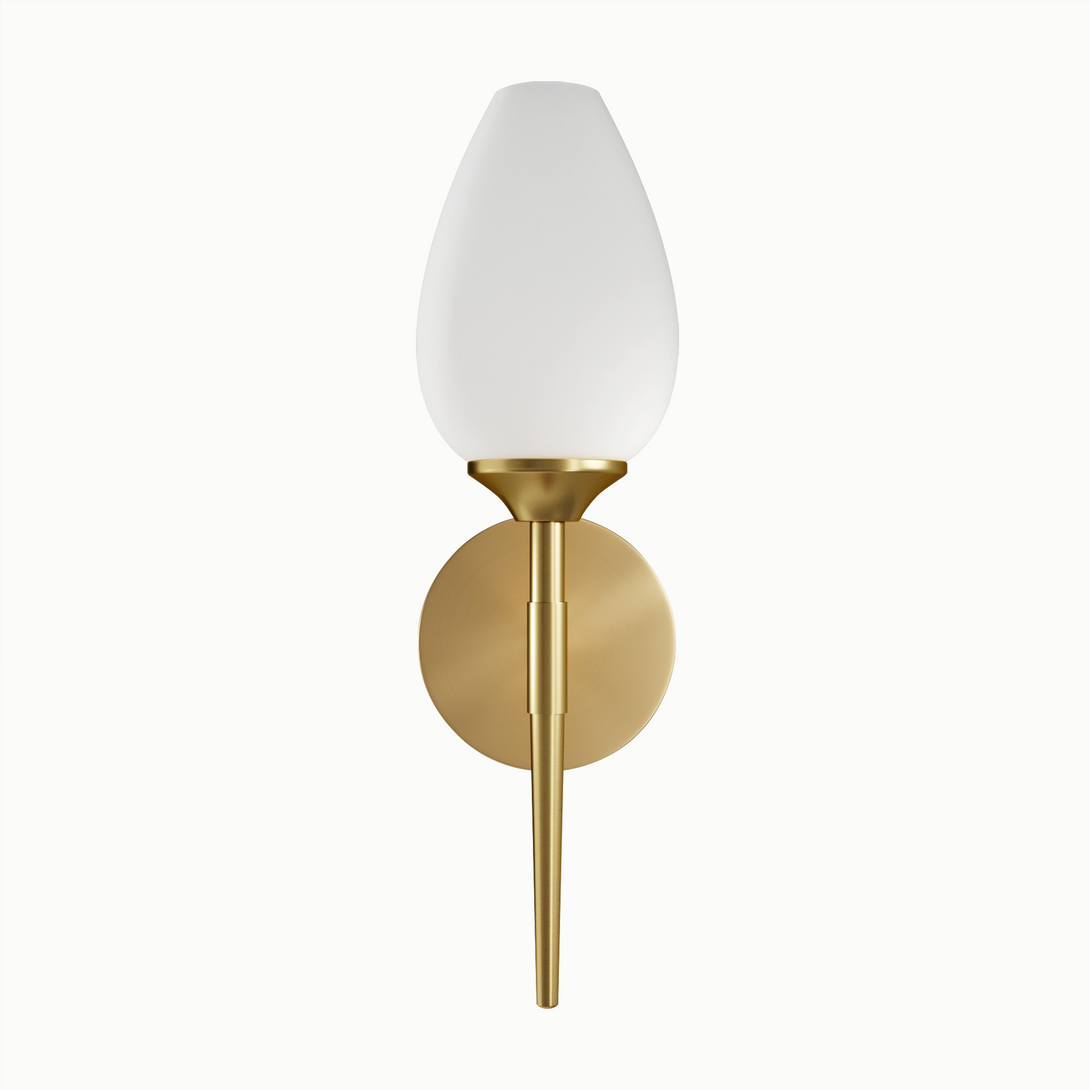
The same mirror can support different lighting layouts depending on the fixture. A tall, narrow sconce uses vertical wall area efficiently and can frame a mirror without needing a large horizontal gap. A globe or wide decorative shade may need more breathing room. A deep projecting fixture may be visually attractive from the front but intrusive in a narrow powder room.
Shade material matters too. Frosted or layered glass can reduce direct views of the lamp compared with fully clear glass, but “frosted” is not the same as “glare-free.” The final experience depends on lamp brightness, shade coverage, viewing angle, room contrast, and the other light sources in the bathroom.
Three common mistakes that make a vanity wall feel wrong
Mistake 1: centering on the mirror while ignoring the face
The mirror is architecture; the face is the task. If the light is positioned only for visual symmetry, the brightest part of the fixture may end up too far above, below, or outside the useful face zone.
Mistake 2: choosing side sconces without checking total wall width
A pair consumes more wall than most product thumbnails suggest. The mirror, two fixture bodies, two gaps, and outside clearances all need to fit. If the total composition is compressed, an above-mirror solution may look more intentional.
Mistake 3: treating a room-category label as a technical rating
A “bathroom lighting” category helps users discover products. It does not replace the exact product's specifications. Verify the current rating and installation guidance for the exact fixture and exact bathroom position before purchase.
What to send WREA before ordering
If you are deciding between a pair and one above-mirror fixture, send one straight-on photo of the vanity wall, the mirror width and height, vanity width, wall width, ceiling height, nearby door or cabinet clearances, existing electrical-point locations, and the product link you are considering. WREA's Contact page accepts room details and product links for sizing and installation questions.
You can also browse the current Wall Sconce collection and Bathroom Lighting collection, then compare the exact product specifications before narrowing the layout.
FAQ
Are side sconces always better than a light above the bathroom mirror?
No. Side sconces are a strong starting option when the wall has enough width and you want light closer to face level from both sides. An above-mirror fixture can be the better architectural solution when side clearance is tight, the mirror is wide, or the room has one practical centered position. The fixture's shade, lamp position, and surrounding lighting still matter.
Should bathroom sconces line up with the center of the mirror?
Not automatically. The complete layout should consider the mirror, the standing face zone, the fixture's full height and width, and the visible lamp position. A backplate center can be mathematically aligned while the actual shade or bulb sits in an awkward place.
How far should sconces sit from the side of a mirror?
There is no single spacing that works for every mirror and sconce. Use the exact mirror width and fixture width to mock up the total composition. Leave enough visual separation that the fixture does not crowd the mirror, while keeping the lights connected to the vanity rather than drifting toward the side walls.
Can I use any wall sconce from a bathroom collection near a vanity?
No assumption should be made from the collection label alone. Check the exact product's current ingress-protection or damp/wet-location information, manufacturer instructions, planned location relative to water, and local requirements. If suitability is unclear, ask before ordering.
What should I measure before buying bathroom wall sconces?
At minimum: vanity width, mirror width and height, available wall width on both sides, mirror-top clearance, ceiling height, existing electrical-point locations, nearby door/cabinet clearances, and the exact fixture's width, height, backplate size, and projection when available.
Can I move the existing electrical box myself to make the layout work?
This guide does not provide DIY electrical relocation instructions. Existing wiring, junction boxes, grounding, wall conditions, mounting, and code requirements should be reviewed by a licensed electrician or other appropriate professional.
Decide the wall before you decide the fixture.
A bathroom sconce should make sense from the doorway, at the mirror, and at the wall itself. Send WREA a straight-on vanity photo, mirror dimensions, electrical-point locations, and the fixture you are considering. We can help you organize the scale and placement questions before you order; the final electrical and site-specific installation decisions remain with the appropriate qualified professional.
Send Your Room DetailsFollow WREA
Lighting notes, room studies, material details, and new arrivals.


